
1. “Show me the code”: code used to be hard currency
“Talk is cheap. Show me the code.”
In August 2000, Linus Torvalds wrote that line in an email, and it has since been held as gospel by countless programmers. The logic is simple: suppose someone claims they made a program 20% faster — until you've seen the source code, that claim could be entirely false. Maybe they only tuned for the benchmark and it doesn't carry over elsewhere; maybe they pulled some cheap trick; or maybe they did nothing at all, and it's all talk. Source code matters precisely because of reproducibility: anyone, anywhere, on any device, can verify whether that 20% is real, if they want to.
2. “Code is cheap”: the barrier to writing code caved in
But all of this stopped holding the moment Transformers started taking off. Someone who has never learned to program can, armed with nothing but natural language and a good idea, get a project off the ground (the quality, how polished the execution is, and so on — that's a whole other topic). Because the barrier to writing code has been lowered to almost nothing, at this stage it already feels like “Code is cheap. Show me the idea.”
3. Even ideas aren't scarce anymore
But as the Transformer's scaling laws keep delivering, I've come to feel that even ideas aren't worth much anymore — because within an existing framework, a Transformer can generate a near-infinite number of them. Some will say: sure, a Transformer is strong at recombining and exploring inside an existing framework, but it can't do paradigm-shift-level innovation. My take on that is this: the humans who can actually innovate at that level are vanishingly rare across all of history. What most people do is, at most, recombination within an existing framework; the slightly more advanced ones do exploratory innovation — and that is precisely what a Transformer is best at. On top of that, the Transformer's explosive arrival is only a few years old. If you used Anthropic's Fable 5 before it was taken down, you'll know its jump over the previous-generation Opus 4.8 was no small thing. It's hard to even imagine what it'll look like in one year, five years, ten years (the worst-case ending, of course, is that we hit the Transformer's ceiling — because human knowledge runs dry before AGI/ASI arrives and self-learning still can't be cracked, or the model's effective context length can't be pushed any further, and so on). Either way, the change Transformers have brought to human society is already profound and irreversible. Coming back to where this paragraph started: at this stage, I think even ideas themselves are no longer scarce.
4. The tipping point: AI isn't free
But the Transformer's tipping point — at least at the capital-markets level — has arrived. On 23 June, US tech stocks sold off hard: the Nasdaq Composite fell about 2% intraday and the Philadelphia Semiconductor Index plunged as much as 7.9%, as investors worried that the four major cloud providers' combined $600–700 billion of AI capital expenditure this year would be hard to monetize quickly (see NPR's coverage). Investors, companies, and users alike are now starting to realize: AI isn't free. And unlike the internet, the Transformer — apart from the leading model companies and the firms selling GPUs, data, electricity, and the picks-and-shovels around them — has created almost no new way to make money; if anything, it's made the companies that were already making money more efficient at it, with lower headcount costs (one person + an Agent Teams/Swarm flat-out outproduces a real human team, at a fraction of the cost). And thanks to the siphon effect, the much-hyped “super-individual” hasn't really materialized either. One reason, I think, is precisely that Transformers lowered the barrier in nearly every industry: if you want outsized profit but have no moat and no way to get the same exposure as the big players, then it's naturally very hard to break out.
5. “Show me your API keys”: what's most valuable now
A more interesting question: if you ask a vibe coder (or one of those people who think of themselves as super-individuals) to line up the money they've poured into AI subscriptions against what they've actually made from the projects they built with AI — most would just turn red in the face. The ways an ordinary person can actually turn AI into money are still the same old few (sell a book, sell a course, or sell anxiety), or else doubling down on a business that was already profitable before Transformers. And what the lowered barrier also brings is near-foreseeable mass unemployment — plus, as free and open-source projects grow more numerous and better, the pool of users who genuinely need to, and are willing to, pay only keeps shrinking.
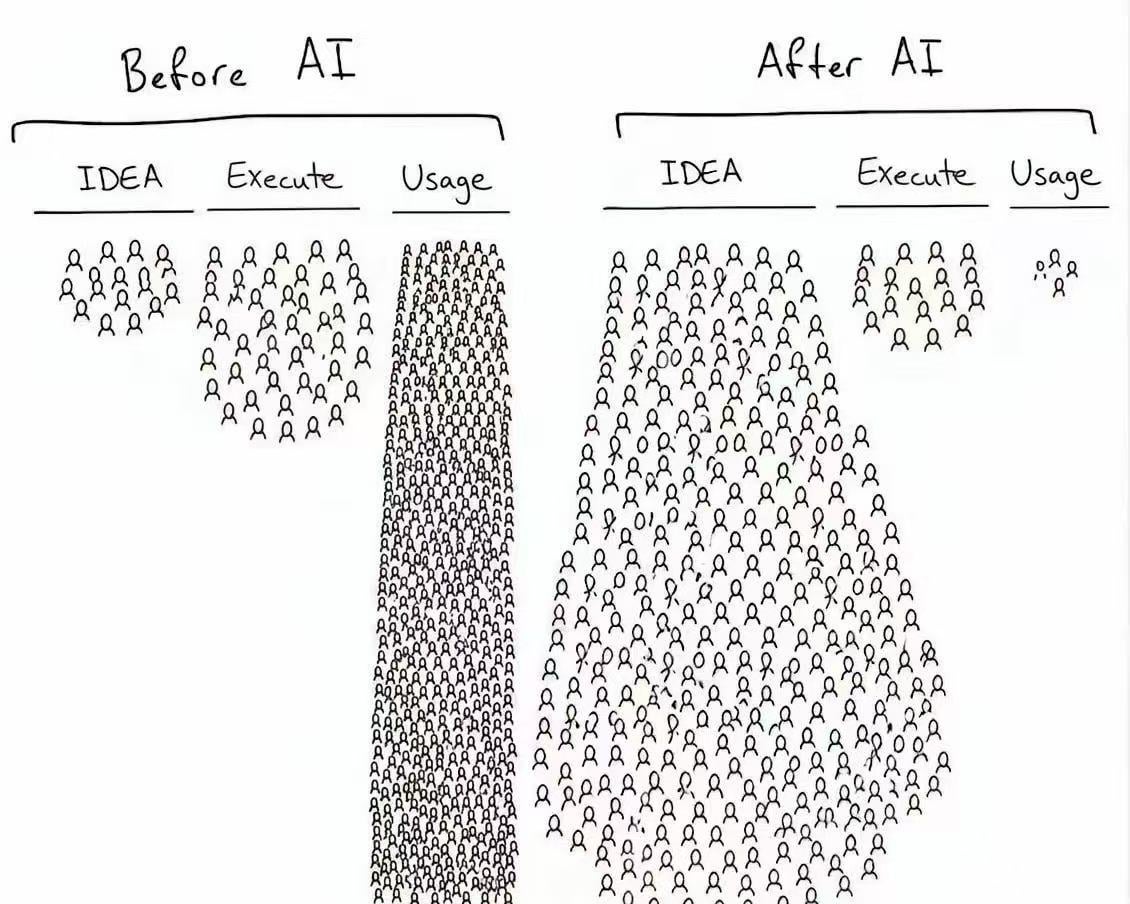
So if you ask today's me how I read Linus's famous line, I'll tell you: we're now at the “Code is cheap. Show me your API keys.” stage.
6. Epilogue
When did I become an effective accelerationist? Probably all the way back to the moment I first fiddled with a piece of electronics as a kid (even though the term itself didn't appear until 2022). But if you ask me now — is effective accelerationism right? — I find I no longer know the answer.